
The Trouble with MMP
The Constitution may make MMP more trouble than it is worth.

Under mixed-member proportional representation systems, voters have two votes: one for a local representative (single-member district) and one for a party in a nationwide proportional vote. Extra seats are added so that the overall results are proportional (i.e. if Greens won 5% of the vote but no single-member districts, Greens would get some compensatory seats so that Greens get 5% of the total seats regardless).
These compensatory seats are based on a national vote in systems that use MMP (Germany, New Zealand). The problem is that the US Constitution requires that House members are elected by states, not nationally. This would mean that any MMP system federally in the US would require a statewide MMP system based on statewide votes, not national vote percentages.
A seemingly simple solution is to expand the House and use these seats as compensatory seats. That is what Paul Starr advocated for in his recent piece in The American Prospect. Starr recommends expanding the House by 145 seats, which may sound like a lot, but when it is divided between the states, most states would see very little expansion. Half of the states would see two or fewer compensatory seats, hardly enough to ensure proportionality. Germany ensures proportionality with over 300 compensatory seats nationally.
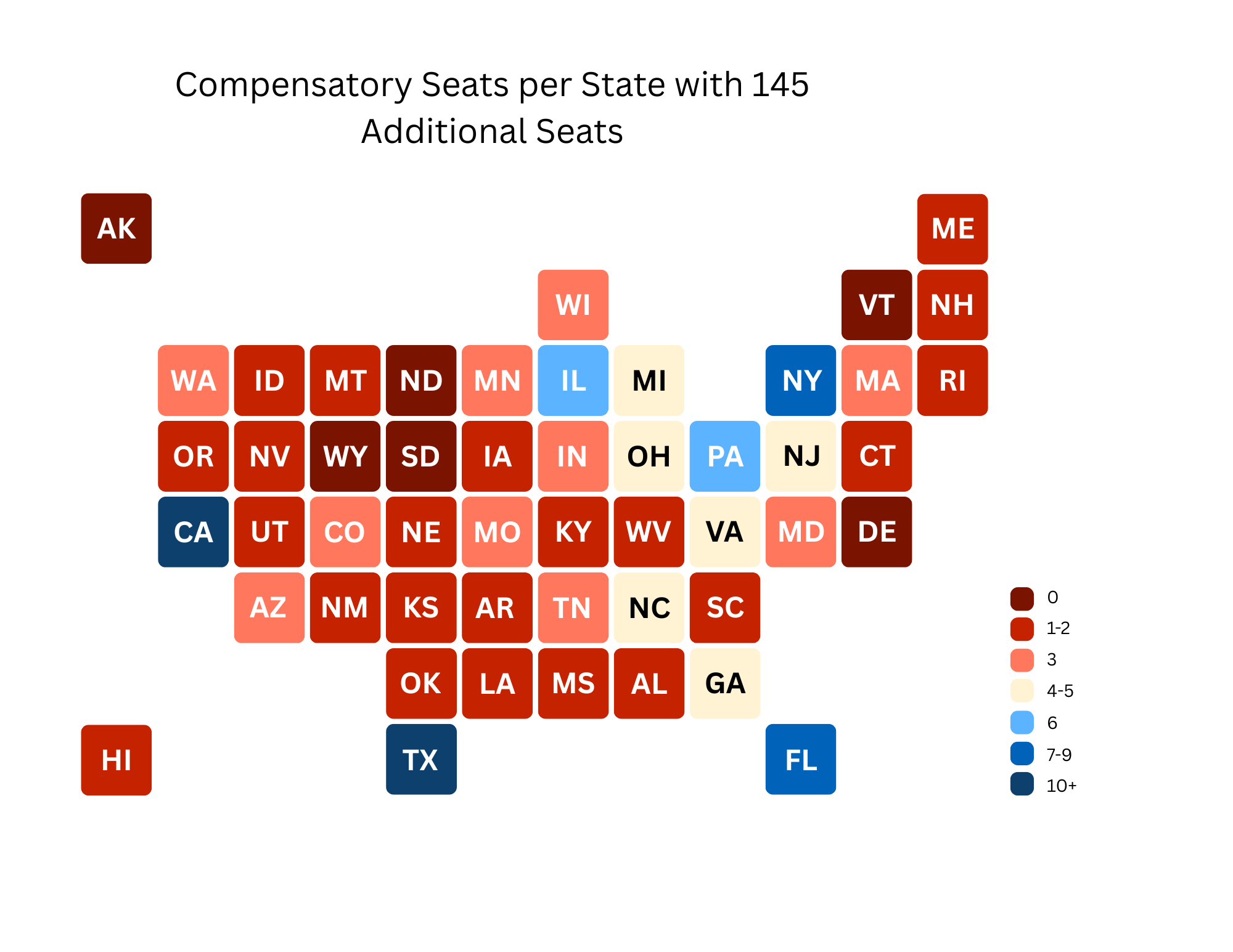
Formula to get a rough estimate number of added seats per state: New number of seats= (current number of seats x new total number of seats)/435. Obviously, Congress uses a more precise model and people have moved since 2020, but this is just to get a general layout.
Since we would be apportioning by state and not nationally, threshold limits would be a key limiting factor as to who would be elected to Congress. Starr seems to view this as a feature, not a bug, saying, “the mixed-member proposal I’ve described does not threaten to upend the two parties.”
Granted many high-profile Democrats’ negative reactions to a few DSA members winning primaries against Democratic incumbents, I would question whether the parties would find this plan non-threatening. Many or all of the 10+ compensatory seats in California and Texas could go to third parties with a pretty low percentage of the vote (third parties would only need to win around 14% of the vote in California to win all the compensatory seats under this plan). These seats could also be key to a House majority. This would be much more than just internal party coalitions, which the parties are struggling to deal with currently. Even if the compensatory seats go to the two major parties, there is no guarantee that the choice of who these members are would be a smooth transition. It is hard to imagine that party-picked Massachusetts compensatory Republicans would resemble the “New England Republicans” Starr describes.
We could also see an electoral college effect in House races under this plan, where third-party competition and ad-spending arises in the biggest states (NY, FL, TX, and CA), since third parties would effectively be locked out of power in most states (and completely in very small states with no compensatory seats).
If you add in the possibility of more spoiled single-member races due to third-party groundswell, it is hard to imagine federal MMP being an overwhelming success.
There is a reason most PR advocates are calling for open-list PR or ranked-choice PR (single transferable vote). Open-list is straightforward and simple. STV solves vote-splitting issues and may ensure more diversity. What issue does federal MMP solve? PR of any kind opens the door to more parties. If we accept this and still forge forward to create a fairer, more equitable democracy, it’s clear that a federal MMP bill would not achieve these goals. MMP in the United States would enfranchise some voters more than others, would threaten the two parties without allowing a healthy split into new coalitional parties, and would result in widespread election distrust due to its convoluted and “unfair” outcomes.
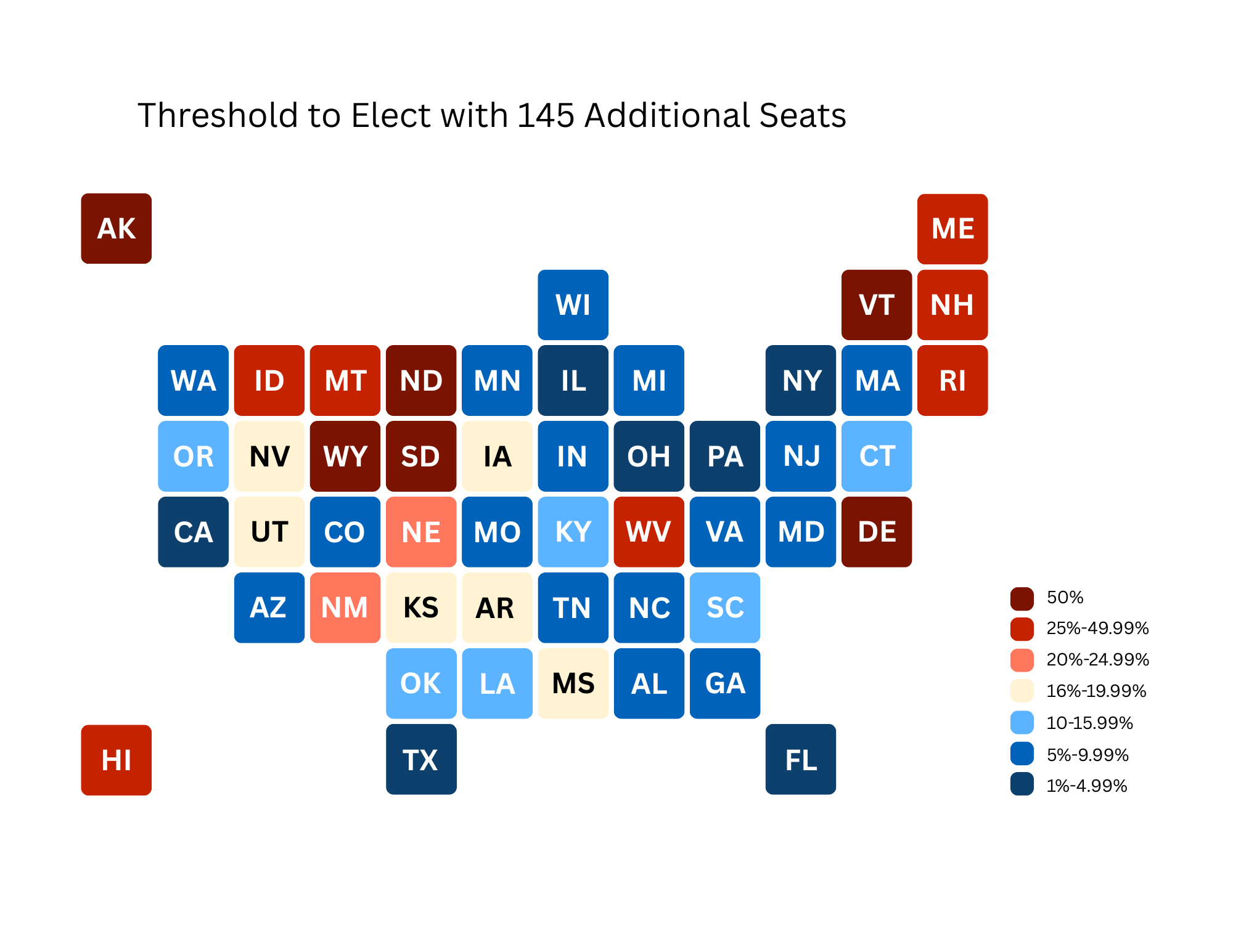
The threshold was calculated using the droop method: 1/(number of seats to be elected +1). In a straightforward PR system, such as open-list (OLPR), there would be disparities between states with only 145 added seats, but there are many states opportunities for third, fourth, and fifth parties to enter Congress. Voters in nearly all states would have more choices, and the election would seem much fairer than Starr’s MMP proposal.